
Are Urban EB-5 Projects Really Safer Than Rural Ones?
It is a common investor belief that Urban is safer when it comes to EB-5 project safety. The burning question amongst investors today is where to invest the money for EB5? Which project type provides more security?
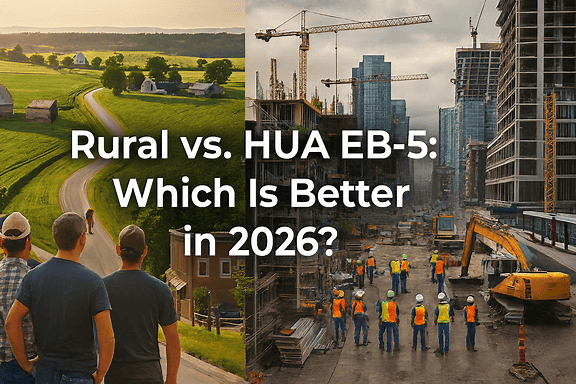
The debate around Rural vs HUA EB-5 is stronger than ever! The root cause of this is that investors believe if a project is in an urban area then it is inherently safer just because of location often completely disregarding the important parameters of due diligence and the facts
This blog will clarify speed, risk, capital safety, and visa backlog in both categories and back this topic with facts.
What Changed After the EB-5 Reform and Integrity Act of 2022?
The EB-5 Reform and Integrity Act of 2022 changed EB-5 for the better with stricter regulations and program changes amongst which the set-aside categories and rural projects are a game changer for Indian investors
Since the EB5 Reform and Integrity Act 2022, Rural investments have been given a clear structural advantage by the U.S. government and the difference today is not just theoretical, it’s practical and measurable.
Here’s what rural EB5 project offers:
Priority Processing
Under the new law, rural petitions qualify for EB5 priority processing. This means the USCIS reviews Rural petitions before all other categories
Since USCIS reviews rural I-526E petitions ahead of other categories. The result is significantly faster adjudication timelines compared to urban or HUA filings.
Reserved Visa Allocation
The EB5 Reform and Integrity Act 2022 carved out 20% of the total annual EB-5 visa quota exclusively for rural investors. Followed by half allocation ie,10% for High Unemployment and only 2% for Infrastructure projects
This reserved category reduces backlog exposure and protects rural applicants from the retrogression pressures that high-unemployment area (HUA) investors may face.
Real-World Approval Timelines
Post RIA 2022 the changes were not just on paper but the results were seen practically by investors. We are seeing rural investors receive I-526E approvals in as little as 6 months — and in many cases, even 3 to 4 months.
By contrast, urban and HUA cases are commonly taking 1.5 to 2.5 years or longer.
The Bottom Line
If your objective is an EB5 faster green card and quicker mobility to the United States, the structure of the EB5 Reform and Integrity Act 2022 clearly favours a rural EB5 project.
Today, both the law and real-world data strongly support rural as the most time-efficient pathway within the EB-5 program.
The Biggest Myth About Rural EB-5 Projects
Let’s address the elephant in the room. The biggest misconception today is people assuming rural area location means risky. That’s simply not accurate!
In fact under the EB5 Reform and Integrity Act 2022, rural projects receive priority processing and reserved visas. When it comes to EB5 project safety, geography alone tells you nothing.
Location is not a measure of risk but the structure of the project determines the risk.
What Actually Determines EB-5 Project Safety?
When evaluating an EB-5 opportunity, serious investors look beyond marketing decks and location claims. EB-5 project safety is determined by structure, governance, and execution discipline. Here’s a deeper look at the real drivers from due diligence perspective:
Developer Track Record
- This is the foundation of risk assessment.
- Has the developer completed similar-sized projects on time and on budget?
- Do they have prior EB-5 repayment history?
- Is their balance sheet strong enough to absorb delays or cost overruns?
- An experienced developer with liquidity and institutional funding relationships significantly reduces execution risk.
Regional Center Credibility
- Post–RIA, the compliance standards for regional centres are stricter.
- Investors need to know how many I-526E and I-829 approvals have they secured?
- Do they follow strong reporting and transparency practices?
- Is their compliance record clean?
- A credible Regional Center acts as the governance layer protecting investor interests.
Capital Stack Structure –
- This is where financial sophistication matters most.
- What percentage is senior bank debt?
- How much equity is the developer contributing?
- Is EB-5 positioned as mezzanine debt, preferred equity, or another layer?
- A conservative capital stack with meaningful developer equity signals alignment and improves downside protection.
Job Creation Buffer
- Immigration success (Conditional Green Card) depends on job numbers created per investor in the project.
- How many jobs are created compared to the required number per investor?
- How many are projected to be created as the project completes certain stages?
- What is the percentage cushion?
A strong job creation buffer protects investors even if revenue projections soften and reduces immigration risk.
Third-Party Fund Administration
- Independent fund administration adds structural discipline.
- Is capital held in escrow?
- Are disbursements independently monitored?
- Is there periodic reporting?
- This reduces the risk of misuse of funds and increases accountability.
Litigation History
- This is again an important red flag that should not be overlooked and matters more than an urban location. Past patterns matter.
- Has the developer or Regional Center faced securities litigation?
- Are there unresolved investor disputes?
- Have they cleared earlier litigation before launching new projects?
- A clean legal history reflects stronger governance and ethical standards.
Exit Strategy Clarity
- Repayment is not automatic.It must be engineered.
- What is the primary repayment source (refinance, sale, cash flow)?
- Is the timeline realistic?
- Does it align with EB-5 sustainment requirements?
- A vague or overly optimistic exit plan is a major red flag.
- These are the real drivers of EB5 project safety. Not whether a project is rural or urban.
- Hence for families evaluating an EB5 investment from India, the question should never be
“Is it rural?”. The right question is “Is it structurally sound, institutionally governed, and conservatively underwritten?” - Smart investors don’t chase geography, They analyze fundamentals!
When Should You Choose Rural EB-5?
Choosing between categories isn’t about hype,it’s about your immigration position and risk priorities. Here’s a practical breakdown:
If You Are Outside the United States ; Priority here is Faster Visa
If you are waiting abroad and your main goal is quicker visa issuance, BTW Rural vs HUA EB-5 :- Rural EB5 project makes strategic sense due to the following:
- Priority processing
- 20% reserved visa allocation
- Lower backlog exposure
- If your objective is an EB5 faster green card, rural is typically the most time-efficient route under current rules. When speed to visa interview matters most rural is the logical choice
If You Are Inside the U.S. (H1B / F1 / L1)
You may qualify for concurrent filing, which allows you to:
- File I-526E and I-485 together
- Receive EAD (work permit)
- Receive Advance Parole (travel document)
- This gives immediate flexibility — often within months.
- Even here, rural still helps because:
- Faster I-526E approval
- Reduced long-term backlog risk
- Smoother transition to permanent residency
- If your visa status feels restrictive or uncertain, rural accelerates overall green card certainty.
If Your Priority Is Maximum Capital Protection
- Now the discussion shifts.
- Speed is important but structure of investment is critical.
- A well-structured urban HUA project with:
- Strong developer
- Conservative capital stack
- Solid job buffer can be safer than a weak rural deal.
Decision logic:
You are not in a rush for the Green Card because EAD & Advance Parole already cover your needs, Then you can choose either Rural or HUA whichever project is structurally safer. If speed is priority it’s wise to lean towards a rural EB-5 project between Rural vs HUA EB-5. If capital protection is a priority, choose the project with stronger fundamentals, whether rural or HUA.
The smartest decision balances:
- Immigration timeline
- Visa position
- Capital structure
- Risk tolerance
- That’s how you choose strategically not emotionally.
Retrogression Risk — What Indian Investors Must Understand in 2026
For Indian families, retrogression is no longer a theoretical concept. It’s a strategic planning variable.
Under the EB5 reserved visa categories, Rural vs HUA EB-5 rural, high-unemployment, and infrastructure projects receive set-aside quotas. On paper, this reduces backlog risk. But 2026 introduces a more nuanced reality.
Reserved Category Backlog Risk
Reserved does not mean unlimited.
Each category has an annual cap. If demand from Indian investors rises sharply, especially in rural area projects, pressure can build quickly.
The key question is not “Is it reserved?”
It’s “How fast is demand growing relative to supply?”
Rising Demand in Rural
Rural has become the dominant preference due to priority processing and visa protection. As more investors shift toward this segment, approval speed may remain strong but visa availability could tighten. This is how silent backlog pressure begins.
Invisible Retrogression
Retrogression doesn’t always appear suddenly. It builds quietly:
Petitions surge
Approvals increase
Visa allocation gets consumed
By the time the Visa Bulletin reflects movement, the pipeline is already full.
This is why EB5 Processing Time 2026 must be evaluated not just at the petition stage but at the visa allocation stage.
Infrastructure 2% Cap. Small but important detail
Infrastructure projects receive only 2% of annual allocation. While niche, this small cap can experience volatility faster if demand concentrates there. Serious investors monitor these micro-allocations closely.
The strategic takeaway is that this is not about fear. It’s about timing and positioning. Reserved categories reduce risk compared to unreserved pools but high-demand segments can still experience pressure if filings accelerate.
Outlook for 2026
For Indian investors, 2026 is about understanding supply-demand math, not marketing narratives. Smart planning today prevents waiting tomorrow. So here’s the bottom line. You don’t choose Rural vs HUA EB-5 based on fear or perception. You choose based on strategy. Both can be safe if the fundamentals are strong. Both can be risky if the fundamentals are weak. Smart investors evaluate the project, not the pin code!
About Acquest Advisors
Acquest Advisors is a Trusted Immigration Consultant Agency specializing in Business Immigration and Residency/Citizenship by Investment programs across the U.S., Europe, and the UAE.
We offer comprehensive, end-to-end support, assisting clients with source of funds planning, and investment selection—whether in projects, property, or business, as well as documentation, business plan preparation, and foreign remittance. Our dedicated team ensures a smooth and hassle-free immigration journey.